Saturday, February 23, 2013

Howard Buffett comes to The Gambia


Last week was a rather interesting week at the WFP.  Howard Buffett, the son of Warren, came to town.  He has a farming background and has been a WFP Ambassador Against Hunger for several years and visited The Gambia as part of a multi-nation tour of Africa.  Needless to say, the WFP office here was in a tizzy before he arrived.  We had to choose three schools with decent school gardens that were relatively close to  airport so we could get him back to the airport after a whirlwind visit, less than 24 hours. I was not invited to the dinner the evening before or the meeting at the vice president's office.  Even though I was not there I thought I would include a picture taken in the her office.  She is the woman in white in the picture.  I recently discovered that if you double click on the pictures in the blog, it will bring them up in bigger format.  I would recommend doing it with this one just to see the detail in the picture.  At the back of the room you can see a picture of President Jammeh. 


I had to throw one more vice president picture in because I got a kick out of it.  In this picture Vitoria is presenting a computer to the vice president to represent the equipment we will be presenting to the regional office.  Everyone in the picture is looking at VItoria and the VP except Mr. Buffetts new assistant who is looking at the camera with the stock Hollywood glamour pose.


The remaining pictures were all taken during the part of the visit in which I was included.  We ended up going to two schools with good school gardens.  We had to tell the third school we would not make it. When we arrived at the first school the student body was lined up along the driveway singing a welcome song and clapping to the music.  The girls were all on one side and the boys were on the other so Mr. Buffett went down both rows slapping the girls' hands and fist bumping the boys.


Then he and one of the teachers held hands and kick stepped their way back.  As you can tell he is not a very formal kind of guy.

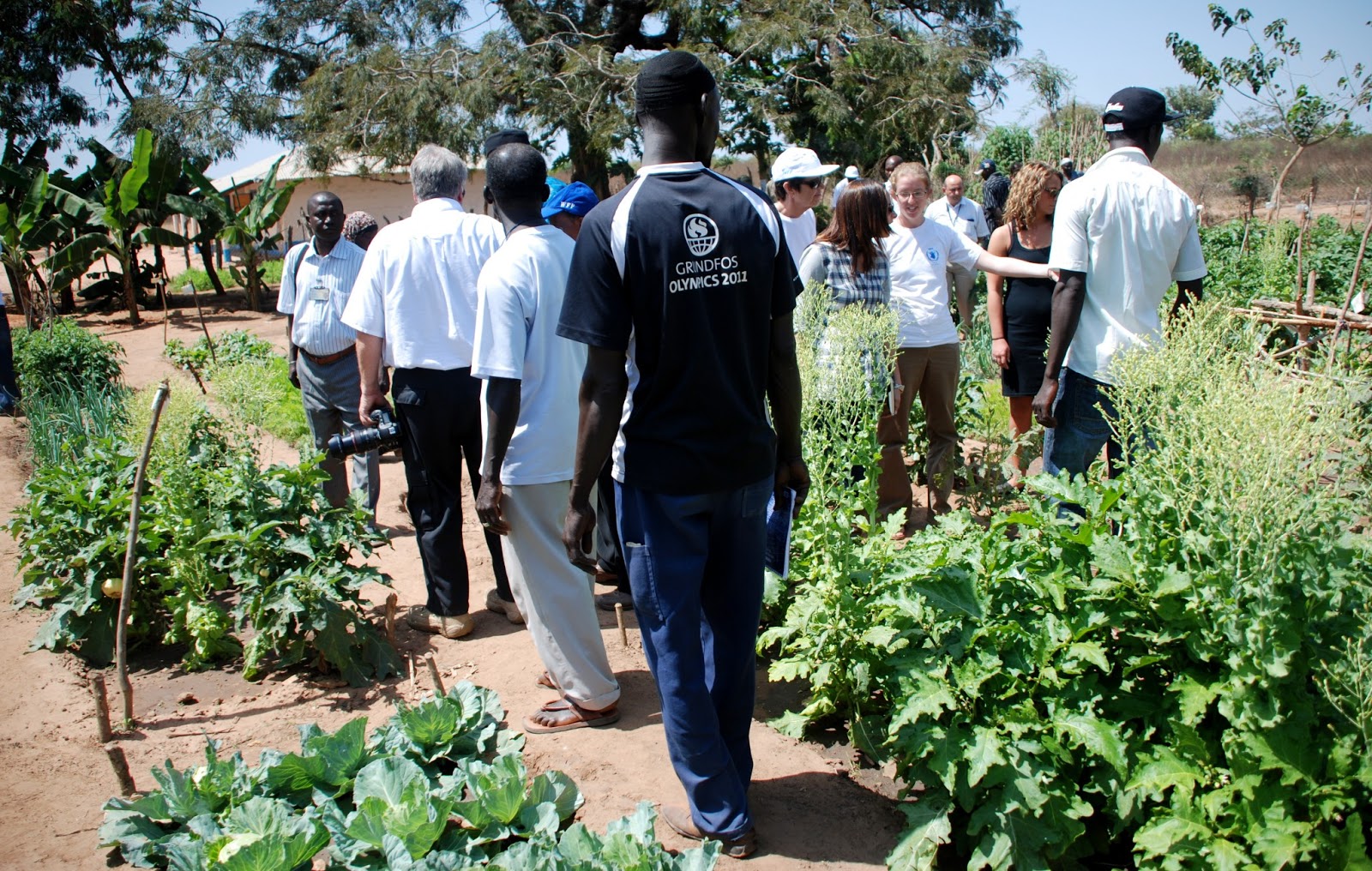
The first place we went we got to the school was the school garden.  One of the first things that Mr. Buffett did was to grab a handful of dirt, rub it through his fingers, and smell it.  He was not very impressed with the dirt -- needed more organic matter.  That made me smile because I had recommended composting at every garden I visited in December.


In the picture below, our WFP country director Vitoria is with Mr. Buffett.  She recently cut all her hair very short but used to have elaborate braids etc.  Since having the braiding done takes hours, I would probably do the same if I was in her place.  The stick that has leaves on the top of it, in the lower left of the bed they are looking at, is cassava.  To harvest it they cut the plant down and eat the roots.  But then they cut the woody part of the plant into pieces and stick the pieces into the garden.  They root and create more cassava plants  The one in the picture has just started the process of growing into a larger plant after having already been part of a larger plant.

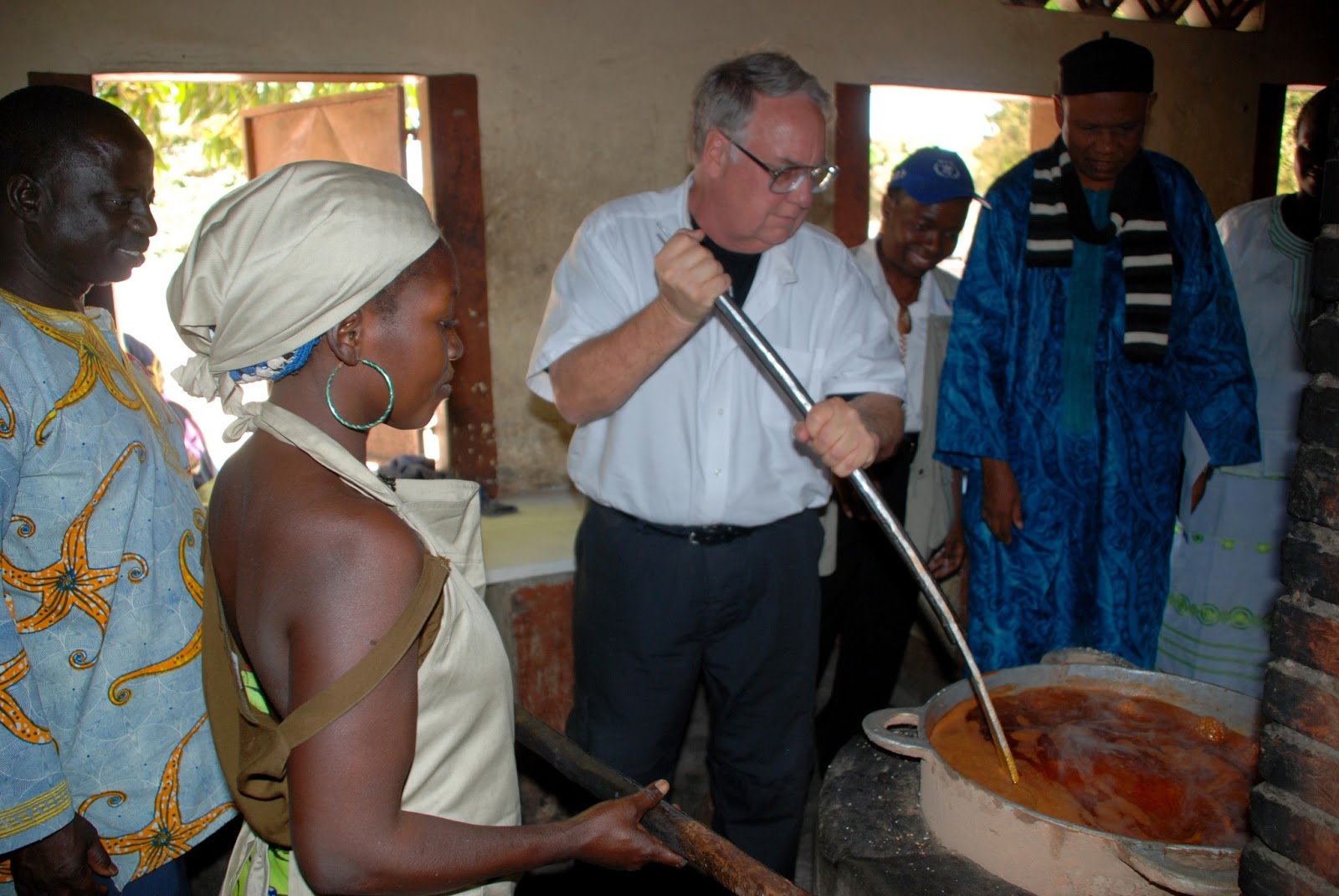
In my post on my trek I showed you a school kitchen that was not being used. This one is in full swing-- the cook was making benecin, a Gambian dish with rice soaking up a sauce -- a Gambian verson of dirty rice.  Mr. Buffett and Vitoria both took turns doing the stirring and then turned it back over to the cook.  As you can see she has some good muscles in her arms from stirring these giant pots.

Here is the school store of WFP food and equipment.  The rice is front and center, the peas at the back right, the salt in the middle of the back and the oil is in the boxes.  These pallets are the latest and greatest WFP version -- not enviromentally sound but won't break and allows lots of air flow around the food.
We visited math class and Mr. Buffet sat himself down in one of the children's chairs which the children got a big kick out of.  They had were doing fill in the blank number math problems and, on the most complicated one, kids were doing random guesses.  Mr. Buffet stuck up for the student sitting next to him and called the teachers attention to the fact that the boy had given the right answer.  The man in the blue robe is the Minister of Education who came with us on the visits.

Then it was time for a program.  The children performed a drama (they love dramas) that was focused on school feeding.  The boy in the suit at the end of the table is playing a man from the WFP giving the parents and children the news that they will be receiving WFP school feeding.

The drama ended with the kids getting a food bowl with Vitoria joining in.

The PTA made a short presentation and then began to dance accompanied by drums.  If you look at the left of the picture you can see one of the drummers who has a whistle in his mouth.  Blowing a whistle while drumming is often done in group performances.  As you can see, Mr. Buffett jumped up to participate.

When the festivities were over we hurried off to another school.  This one had a beautiful school garden and also a banana orchard.  But they are no longer receiving school feeding.  WFP does not have the funding for their region.  The dirt was not good there either -- more composting needed.

Here is a Gambian teacher at work.  He was doing phonics and it was pretty interesting to watch him.  He had a string suspended across the classroom with different letters on it.  He would arrange the letters into a word, have the children sound out each letter and then sound out the word.


In one of the classrooms Howard noticed 3 children who had US Flag school bags.  He had them walk out into the yard and took pictures of them with the bags.  I have no idea where they got the bags but it does make a cool picture.

Some singing and dancing by some boys and girls at the school.

As part of the festivities some of the boys bought up a present for Howard.  When he opened the box they had given him a giant papaya they had raised as well as some bananas from the orchard.

Below is the WFP crew who went on the school trip along with Mr. Buffett and one of his assistants(the one in checks).  The background is a map of The Gambia painted on the side of one of the school buildings.  After this was taken we were off again --  some of us to the airport and the rest of us back to the WFP.

All in all in was a pretty interesting day.  He makes an excellent ambassador for the WFP.  His primary  focus was the kids and he loved being with them.  I had all of a 20 second conversation with him.  He asked me where I was from.   When I told him Portland, Oregon, he asked me if I had ever heard of EcoTrust.  I told him I lived across the street from the EcoTrust building.  He said he used to be on the board.  End of conversation.  I don't know exactly how many countries he had been to on this trip but I know there had been quite a few.  Nice to watch a philanthropist in action.  Probably the most fun thing in our preparation was getting the staff to say his name right.  They all wanted to pronounce it like Boofay.  Luckily we Americans were there to save the day. 


Wednesday, February 20, 2013

Random Things

I usually have my camera with me wherever I go and if I think of it I will take it out when I see something interesting (to me anyway).   The picture below is a photo of an aid magazine cover.  Kind of dumb to take a picture of magazine cover but it was an incredible picture and even though it is not West Africa it still has elements that ring true here.  First of all this woman is a living skull.  Now I have not seen anyone who resembles here but there is plenty of hunger in the Gambia. Then the men laughing behind her and one of them raising a glass of tea.  I have no idea what was happening when they took this picture but the juxtaposition of the men and the woman is an amazing contrast. The final thing of note is that she is clasping bottles of vegetable oil to her chest.  The amount of vegetable oil consumed here is incredible. A lot of it in The Gambia is palm oil. 


The next two pictures were taken on my walk to the United Nations.  As I have mentioned before Gambia is a free range country.  I regularly see chickens, goats and sheep walking around the hood on my way to and from work.  However, this day there was a herd of cows walking through.  No one was with these cows and they were just walking.   Then about 3 hours later I was on Kairaba Avenue at Traffic Light and the same herd of cows came strolling by, again without anyone tending them.  Traffic Light is one of the main corners in the entire country so the cows literally stopped traffic.


It probably sounds racist to repeat the euphemism "black don't crack" but living in Africa, I have to say it is true and I am damn jealous.  The woman below recently retired from my office at age 60.   She doesn't take very good pictures but take a look at that face and neck.  Arg, she looks better than I would if I had had plastic surgery.


Here is a Konkuran coming down the street of the village I walk through to come to work.  The Konkuran is a red monster who is part of the male circumcision celebration.  I talked about it in the blog about the dancers during my pre-service training.  But I have run into them several times in different parts of town.  In fact I saw one tonight on my way home.  They are always red, hairy and smack machetes together.  I have seen kids imitate them with torn red tee shirts for costumes and smacking flip flops together.  Gambian children are good at imaginative play.  A couple of times I pretended to be afraid of them and people came to my rescue.  I guess I will have to stop that practice.


For the final random photo I thought I would include one of me in South Africa having  a latte, or what is called a latte in SA. (I had to order extra espresso) The only reason I put this in is because I like the way that I look in it.  The woman in the picture is a PCV in Uganda and had thyroid surgery, hence the scarf.  She is back in Uganda and doing fine.


Tuesday, February 5, 2013

The Incredible Woman Eating Bed

I have already told you in an earlier post about my Gambian bed.  Little did I realize at the time that it is a determined foe.  It all started with minor misbehavior -- I would sit on the side of the bed or lie down to go to sleep and the end of one of the support boards would crash  to the floor, which meant getting up lifting up the mattress to find the errant board and then fixing it.  I was resigned to this until New Years Eve.  I guess my bed wanted to bring in the New Year with a bang -- literally. I got into bed and bang down a board went.  Fixed the board and bang another one went.  Got up and fixed that and then repeated the whole experience two more times.  AAARG!  The bed was defeating me.  At that point I told my woeful tale to Lindsay Roe, my UN co-worker.  She came up with the magical solution to all problems -- duct tape. When I got home that night I carefully duct taped all of the boards to the support boards.  Oh bliss, oh joy, the boards were firmly in place!!

I had tamed the beast.  But I tried to give the bed proper respect.  I tried to avoid sitting on the edge of the bed and would carefully slide into the bed at night, not wanting to anger the bed spirits.  But last week I did the unthinkable and sat on the edge of the bed as I got into bed.  BAM! one of the boards dropped to the floor.  In my  foolishness I decided to ignore it, thinking that the others were securely taped and went to sleep. When I woke up in the morning I was disoriented.  I could not figure out how to get out of bed.  Then I realized that both the foot and head of the mattress were upraised and I was stuck in the middle.  I tried to make my  way to the side but slipped back.  My mind was racing -- was I to remain locked in my house being consumed by a bed -- had any other PCVs been eaten by a bed?  Finally I was able to summon up super human strength and pull myself out of the jaws of the monster bed.  I threw the mattress aside and grabbed my mighty duct tape and wrestled the boards back into submission, applying duct tape as if I owned a duct tape factory.  The beast is tamed for now, but I know that it lies there, waiting for me to make another mistake, so that in can envelope me in its jaws.

Thursday, January 31, 2013

United Nations International Volunteer Day

Every year the United Nations sponsors and International Volunteer Day. Since I work for the United Nations, it may not surprise you to hear that I participated.  It was celebrating volunteerism in general so Peace Corps Volunteers were also included in the event.  The day started with a parade down the middle of Kairaba, the main drag in Fajara, the street on which the US Embassy and the Peace Corps office are located. Kairaba is one of, if not the, most heavily traveled streets in The Gambia with a constant stream of taxis and cars.  Before the event started the various volunteers all grouped in front of the president's bakery and received tee shirts. and waited for things to get under way.  Finally, only about an hour late, the parade got started let by not one band, but two.  We had both an army band and a police band.


As I said Kairaba is the main drag through Toubob land, aka Fajara.  This gives you a little idea of what the good roads are like.  There is one lane in each direction but as you can see there is nothing resembling curbs and sidewalks.  When I walk to the Peace Corps office, I walk on the side of the road as you can see people doing in the picture.  This can be a dicey proposition here because pedestrians definitely do not have the right of way here.  If one of the taxis wants to pick up or let off passengers they just zoom into the roadside and you had better move out of their way.  I regularly curse them but not in a voice that they can hear.  

The pictures below are of the Peace Corps contingent in the parade.  We did not have that many people but we had a good banner.    The woman on the right hand side of the picture with glasses is Lindsay Roe.  She is a third year volunteer who spent the last year at the UN.  Unfortunately for me, she will be going back to the US in March.  She is smart as a whip and a tough act to follow.

I included another picture below to show you the PCV who is a vet who retired after a career as a zoo vet in Philadelphia and did a stint as a PCV in Samoa before doing another in The Gambia. She is the grey haired woman in the middle of the second row.  Unfortunately she went back to the US last Saturday.  I also wanted to call attention to the woman in front of the banner with the camera around her neck.  She is in charge of visibility (aka PR) for the WFP at the UN. You can't quite tell it from the picture but she is a real fashionista.  She is tall to begin with and wears a variety of towering heels in the office.  She is always perfectly accessorized and wears a variety of Gambian and US fashion.  I am a little jealous since I have never had the knack for fashion.  She is applying to a masters program in Windsor, Ontario so we may not have her around for much longer.  As you probably may have figured out her family does have money.

The woman behind the banner  in the black skirt and black tennis shoes with white laces is a UN volunteer from the US.  She was born and raised in the US but her family is from the Gambia.  She lived in the Gambia for a couple of years when she was younger so she speaks fluent Wolof.  She gave me a ride to work one day and pointed out the various ocean front homes that her uncle owns for his various wives.  Needless to say her uncle is wealthy.  She and I worked at a urban food distribution one day (probably need to write about that one) and it was fun to watch her in action.  I am jealous of her language abilities but not jealous enough to work hard to attain the same skills.

Our parade march down the road about a mile to a local soccer stadium.  At one point there was road work so we took up the entire road.  I loved being the one to make the taxis move rather than vice versa. At the stadium there was a little speechifying and then we sat down to wait for the speaker and food that never arrived. Catering is not the most dependable thing here.

The final picture is one that the visibility woman took of all the UN volunteers who made the march.  I think this is the only picture I have with my cast on.  I had been wearing my white sling which is actually covering most of the cast in the picture.  The cast itself was wrapped with an ace bandage since the doctor made the cast in two pieces and then wrapped gauze over the wet plaster to keep it together.  It made it easy to remove the cast but the gauze was a dirt magnet so I usually kept the ace bandage over it.  Once the picture was taken a UN driver came and whisked us back to work.

Sunday, January 20, 2013

School Feeding Trek Part 2

School feeding in The Gambia is provided by the World Food Programme of the United Nations and has been done in The Gambia for over 40 years. WFP provides rice, vegetable oil, iodized salt and split peas and hopefully it will be supplemented by food from the school garden or purchased from a fee that the students pay daily.  If a student cannot pay the fee, they usually will bring payment in kind such as firewood.  The two pictures below show a modern school kitchen.  These are constructed so that the cooks are exposed to the minimum amount of smoke.  The holes are made to fit the cooking pots and the three stoves all vent to a chimney.  There is no running water in the kitchens..  All of the water needs to be brought into the kitchen from the local water source.  As I said this is a modern kitchen and its conditions are the best.  Some of the older kitchens are not a place in which people should be cooking. 


The structure below is a classroom for an Early Childhood Development Center (aka preschool in the USA).
Some of the schools do have actual concrete classrooms for their ECDCs.  But I saw many of this type of classroom on my trek. During the dry season they would not be a problem, but I cannot imagine what they would be like in the rainy season.


Here is a picture inside the classroom.  As you can see they are set up like a classroom inside with desks and blackboards etc. It is hard to tell, but the student directly in front of the blackboard was leading the children in repetitions of the alphabet.  Rote memorization rules here.


We happened to arrive at one school at the beginning of the day.  The students line up have a morning routine they go through that includes singing of the Gambian national anthem.  This is true of all the schools though this is the only place I witnessed it.

The pictures below are from a school garden at one of the schools.  The most important factor for a school garden is a relatively close source of water but the second most important is a fence and a good one. None of the animals are penned during the daytime.  Cows, goats and sheep wander in the villages and the bush.  The goats are especially fond of school gardens.  They love to eat the tender green shoots. The fence below is what we call local fencing.  They gather branches/sticks from the bush and supplement with things like thorny branches.  The problem with this is that the branches dry out and get brittle so the local fences need constant maintenance. In some cases WFP has provided the wire fencing but the fence posts are provide by the village.  However one of the things WFP teaches in school garden training is the use of live fencing.  There are several different kinds of trees that can be used as fence posts.  One of them is Moringa which grows quickly and whose leaves are a nutritional powerhouse.  Others such as sisal can be used as the fence itself.


Below are two pictures of the garden inside this fence.  This school was one of the ones that was farther along with their garden. Many had not even begun their gardens at the time that we visited. As you can see there is nothing in the garden that is at the state that would enable it to supplement the food bowl.  Part of the this is because there is a long summer break for school in the rural areas so that the students can assist with farming.  Unless there is a very active community or student organization the garden is neglected until school starts up again so it is usually a mass of very tall weeds that grew very well during the rainy season. Most of the people in the community are actively involved in farming their own fields so keeping the school garden going is not high on the priority list.  For most farming means bending over with hand tools.  It is not an easy life.

As you can see, a lot of beds have been prepared in the garden.The different beds in the garden are assigned to different students who are in charge of watering, weeding, etc.  The concept is also that school gardens will also be worked into classrooms for practical application of knowledge -- for example how many plants should be planted in a bed  x metres by x metres.
My PCV counterpart in the WFP is finishing with the WFP in 3 weeks and I will be taking over her school garden work so I imagine I will be talking more about school gardens in the future.

This picture is a two pump water source.  I have seen small girls working together to move one of these pumps. They actually jumped up and down to get enough pressure on the handle to make it move.  There is usually just one pump at a location.  I took a picture of this because it said Gift of Saudi Arabia  in Arabic and English.  Unfortunately I did not get the sign in the picture.   It was alongside the highway (not the bush road) and I realized that I had seen several with the sign along the highway.  Now that is good PR. There other types of water sources that I will probably document in the future.  Aren't you excited?


Tuesday, January 8, 2013

Magical Neem Cream


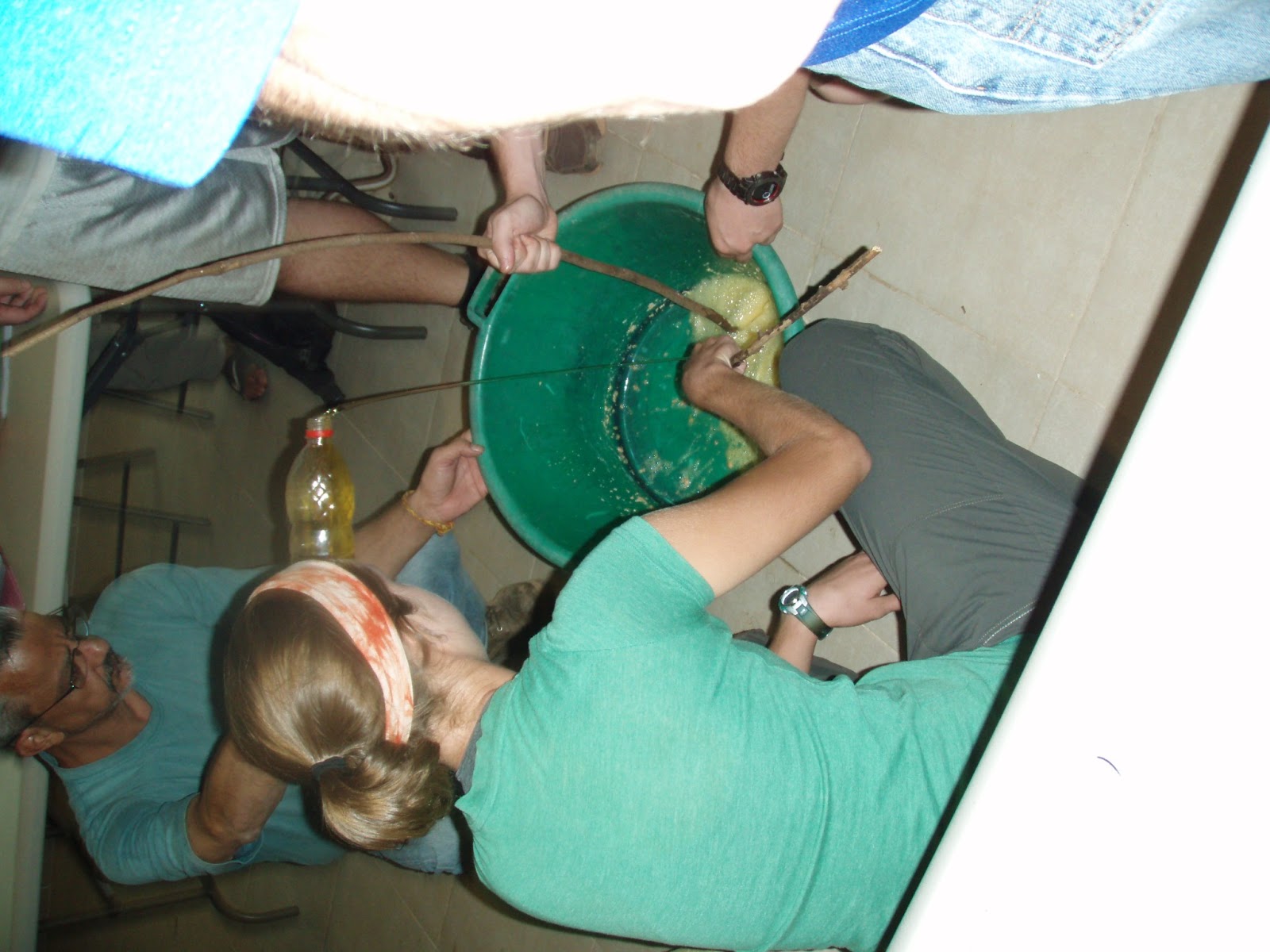
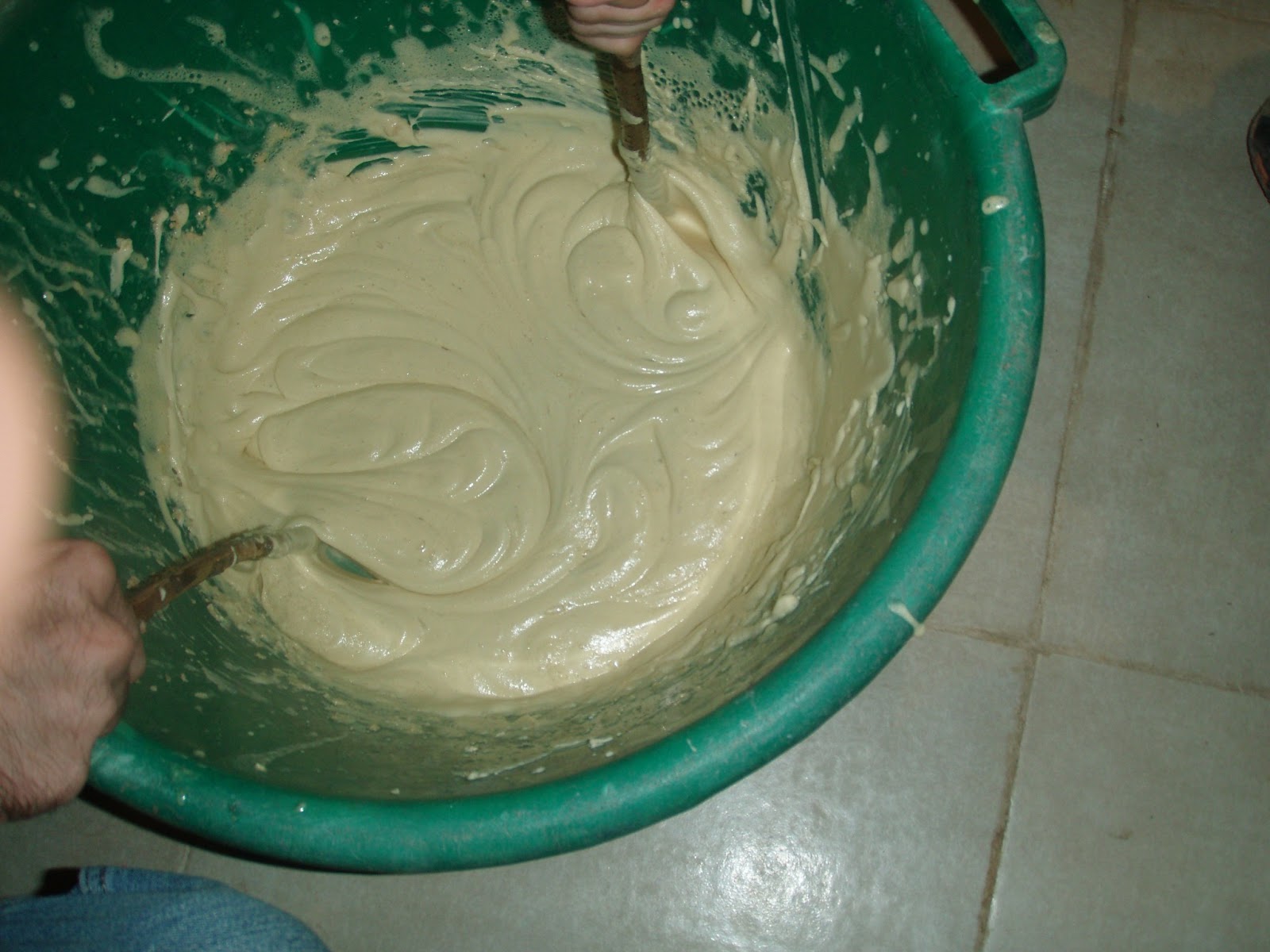
I recently met with my original training group for a week of in service training.  It was definitely more oriented for teachers who are working up country, but there were some interesting parts. One of the hands on things we did was making Neem cream to use as an insect repellent.  Neem trees are all over The Gambia and have a couple of good uses.  If you boil Neem leaves in water until the water becomes dark green, discard the leaves and cool the water, it is a good preventative insecticide. It does not work too well on insects that all already attacking the plants, but it does a pretty good job of keeping them off in the first place.

The other more significant use is to be used in making a mosquito repellent cream.  This is a standby Peace Corps recipe in West Africa but still has not been overdone.  Our class made a batch and as you can see from the pictures it turns into a cream.  It actually smelled ok and felt nice on the skin.  I guess some of the people whom they have taught have continued to make it and sell it since the *#!!**## mosquitoes here are a bitch here and can carry the fatal malaria strain. I have put the pictures in order so if you want to make up a batch feel free -- if you can find the Neem leaves.  I hear they grow in Florida.

The Magic Recipe  
It specifies beauty soap as opposed to laundry bar soap.

Shaving the soap

 Neem Leaves

 Making Neem Tea

Stirring in the Oil

The Finished Product


Sunday, January 6, 2013

Traditional Practices


I recently completed a two day training for Gender and Development with Peace Corps volunteers and their Gambian counterparts whom they had invited to the training.  This was a program that explored gender roles in the Gambia with an emphasis on empowering girls.  Most of it was pretty much what I expected with a couple of exceptions.  One man told us that girls were not allowed to ride horses, climb trees or ride bicycles because of biological reasons.  I was wondering what planet he lived on when he clarified his meaning -- girls could suffer an injury that could cause them to lose their virginity.  Even that was leaving me thunderstruck, but was told by fellow volunteers that when a girl is married she is examined by women in the village to ensure that she is still a virgin.  Apparently, at that point, a broken hymen is a broken hymen and you are not a virgin if it is broken since you could be lying about how it was broken. I did not offer my two cents but I certainly thought them.

The other exception to the discussion was FGC, female genital cutting and FGM, female genital mutilation.  I knew that it was still being practiced in some places in The Gambia, but I had not realized that it was practiced by so many.  About 72% of girls have some form of FGC or FGM.  The large majority are only FGC where the prepuce of the clitoris is removed.  But some tribes go farther and remove the lips of the labia.  A small percentage go even further and after removal sew everything together leaving only a small opening for urine to pass.  When a girl is married who had this procedure, she needs to be cut open for her wedding night because the tissues will have grown together.  Then she has to have sex every day for at least 10 days because the tissues will grow back together unless they are kept open. 

FGM/FGC is illegal in Senegal, there is a 5 year jail sentence.  But Senegal has a large Wolof population.  FGM/FGC have never been part of the Wolof culture.  However it is not illegal in The Gambia, but the medical clinics do their best to educate people and prevent it. It is built into the culture of the remote rural villages and tribes will intermarry.  Our instructor told about a Wolof woman who married a Fula.  She had not been circumcised and that was acceptable to her husband.  But the women in the village would not accept her -- they would hold their noses when they saw her, implying that she smelled.  She asked her husband for permission to be circumcised and had the procedure done -- but not in a health center, they will not perform FGC.  There can be many bad side effects including keloid scarring and the procedure endangers the woman's health so they will not perform the procedure even for a consenting adult woman.

So who performs the procedures? Women do and men are not involved in the ceremony in any way.  There are women who will travel to villages and do the procedures. One of the volunteers was invited by her host mother to witness the event.  After much soul searching and consultation with Peace Corps PCVs and LCFs, she decided there was nothing she could do to prevent it so she would witness it.   In the ceremony 4 girls were circumcised and each brought a new razor blade for her circumcision.  This is not always the case.  Some cutters have knives that have been passed down through generations and not under sterile conditions.  There is no washing of the knife between children.  So obviously infection is a huge risk in these procedures.  The grandmothers of the girls where there and the sisters of the fathers.  The mothers of the girls waited outside -- even though they supported the ritual they could not watch their children be hurt.  3 of the 4 girls were up and about quickly but one of them, the oldest, ran a fever and took longer to recover.

The Gambian man who gave the presentation is part of a Spanish NGO that is working to stop this in The Gambia. I might see if there is something I can do with them as a secondary project.  I have 3 little girls who live next door to me but thankfully they are Senegali Wolofs so I don't think there is any chance of being invited to a ceremony -- a fact for which I am very grateful.

The rational for female circumcision is religious reasons but there is nothing in the Koran about fit and it is not practiced in Saudi Arabia, home of Mecca.  Circumcision for boys is in the Koran but not for girls. If you looked on a a map of Africa and marked the countries that are continuing the practice today, there is a band that stretches right through sub Saharan Africa, the travel route route of the nomadic people.  The Gambia will slowly change.  Gambia supports female education.  Many schools now have more girls than boys.  NGOs will continue to work on this issue.  As  the country modernizes this practice will fade -- I am just sorry that it will take time.  Ndanka, ndanka (slowly, slowly in Wolof).